


Page 39 - FDMAsia NovDec 2024
P. 39
TECHNOLOGY           37
         www.fdmasia.com | FDM ASIA NOV/DEC 2024


            The type of base material, such as particleboard or MDF,
          can also affect the strength of the corner joints. The density
          and gradation of the materials used in furniture can significantly
          affect the joint strength.

            Acrylonitrile butadiene styrene (ABS), PVC, melamine, and
          wood  veneers  are  commonly  used  for  edgebanding.  ABS
          is known for their impact resistance, durability, and overall
          appearance.
            PVC edgebanding is manufactured using high-impact   of the edgebanding material can influence the bending and
          modifiers that provide excellent machinability and impact   tensile strength of the particleboard, which in turn can affect
          resistance. Melamine-impregnated paper is absorbed with   the quality of different glued joints.
          resin and covered with a lacquer surface, resulting in a high   Different methods can be found in the literature to investigate
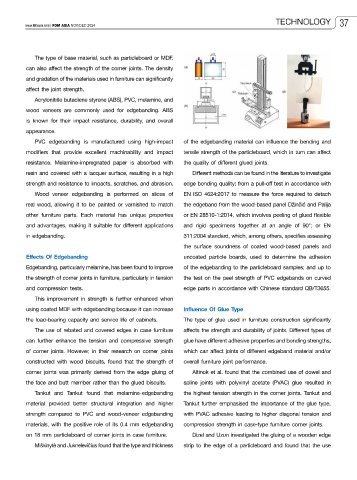
          strength and resistance to impacts, scratches, and abrasion.   edge bonding quality: from a pull-off test in accordance with

            Wood veneer edgebanding is performed on slices of   EN ISO 4624:2017 to measure the force required to detach
          real wood, allowing it to be painted or varnished to match   the edgeband from the wood-based panel Džinčić and Palija
          other furniture parts. Each material has unique properties   or EN 28510-1:2014, which involves peeling of glued flexible
          and advantages, making it suitable for different applications   and rigid specimens together at an angle of 90°; or EN
          in edgebanding.                                    311:2004 standard, which, among others, specifies assessing
                                                             the surface soundness of coated wood-based panels and
          Effects Of Edgebanding                             uncoated particle boards, used to determine the adhesion

          Edgebanding, particularly melamine, has been found to improve   of the edgebanding to the particleboard samples; and up to
          the strength of corner joints in furniture, particularly in tension   the test on the peel strength of PVC edgebands on curved
          and compression tests.                             edge parts in accordance with Chinese standard QB/T3655.
            This improvement in strength is further enhanced when
          using coated MDF with edgebanding because it can increase   Influence Of Glue Type
          the load-bearing capacity and service life of cabinets.   The type of glue used in furniture construction significantly
            The use of rebated and covered edges in case furniture   affects the strength and durability of joints. Different types of
          can further enhance the tension and compressive strength   glue have different adhesive properties and bonding strengths,
          of corner joints. However, in their research on corner joints   which can affect joints of different edgeband material and/or

          constructed with wood biscuits, found that the strength of   overall furniture joint performance.
          corner joints was primarily derived from the edge gluing of   Altinok et al. found that the combined use of dowel and
          the face and butt member rather than the glued biscuits.   spline joints with polyvinyl acetate (PVAC) glue resulted in
            Tankut  and  Tankut  found  that melamine-edgebanding   the highest tension strength in the corner joints. Tankut and
          material provided better structural integration and higher   Tankut further emphasised the importance of the glue type,
          strength  compared to PVC  and  wood-veneer  edgebanding   with PVAC adhesive leading to higher diagonal tension and
          materials, with the positive role of its 0.4 mm edgebanding   compression strength in case-type furniture corner joints.

          on 18 mm particleboard of corner joints in case furniture.   Dizel and Uzun investigated the gluing of a wooden edge
            Miškinytė and Juknelevičius found that the type and thickness   strip to the edge of a particleboard and found that the use

