


Page 46 - FDMAsia JulAug 2024
P. 46
44   TECHNOLOGY                                                                   JUL/AUG 2024 FDM ASIA | www.fdmasia.com


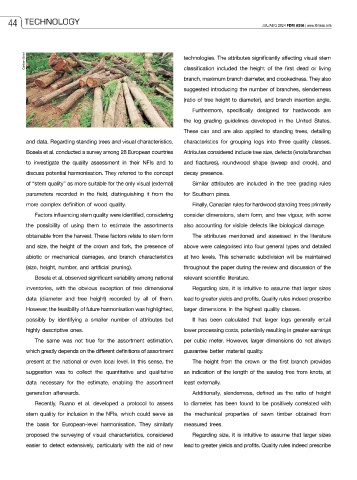
         Carbon Brief                                        technologies. The attributes significantly affecting visual stem
                                                             classification included the height of the first dead or living
                                                             branch, maximum branch diameter, and crookedness. They also
                                                             suggested introducing the number of branches, slenderness

                                                             (ratio of tree height to diameter), and branch insertion angle.
                                                                Furthermore, specifically designed for hardwoods are
                                                             the log grading guidelines developed in the United States.
                                                             These  can  and  are  also  applied  to  standing  trees,  detailing
          and data. Regarding standing trees and visual characteristics,   characteristics for grouping logs into three quality classes.
          Bosela et al. conducted a survey among 28 European countries   Attributes considered include tree size, defects (knots/branches
          to investigate the quality assessment in their NFIs and to   and fractures), roundwood shape (sweep and crook), and
          discuss potential harmonisation. They referred to the concept   decay presence.
          of “stem quality” as more suitable for the only visual (external)   Similar attributes are included in the tree grading rules

          parameters recorded in the field, distinguishing it from the   for Southern pines.
          more complex definition of wood quality.              Finally, Canadian rules for hardwood standing trees primarily
            Factors influencing stem quality were identified, considering   consider dimensions, stem form, and tree vigour, with some
          the possibility of using them to estimate the assortments   also accounting for visible defects like biological damage.
          obtainable from the harvest. These factors relate to stem form   The  attributes  mentioned  and  assessed  in  the  literature
          and size, the height of the crown and fork, the presence of   above were categorised into four general types and detailed
          abiotic or mechanical damages, and branch characteristics   at two levels. This schematic subdivision will be maintained

          (size, height, number, and artificial pruning).    throughout the paper during the review and discussion of the
            Bosela et al. observed significant variability among national   relevant scientific literature.
          inventories,  with  the obvious exception of  tree  dimensional   Regarding size, it is intuitive to assume that larger sizes
          data (diameter and tree height) recorded by all of them.   lead to greater yields and profits. Quality rules indeed prescribe
          However, the feasibility of future harmonisation was highlighted,   larger dimensions in the highest quality classes.
          possibly  by  identifying  a  smaller  number  of  attributes  but   It has been calculated that larger logs generally entail
          highly descriptive ones.                           lower processing costs, potentially resulting in greater earnings
            The same was not true for the assortment estimation,   per cubic meter. However, larger dimensions do not always
          which greatly depends on the different definitions of assortment   guarantee better material quality.

          present at the national or even local level. In this sense, the   The height from the crown or the first branch provides
          suggestion  was  to  collect  the  quantitative  and  qualitative   an indication of the length of the sawlog free from knots, at
          data necessary for the estimate, enabling the assortment   least externally.
          generation afterwards.                                Additionally, slenderness, defined as the ratio of height
            Recently,  Ruano  et  al.  developed  a  protocol  to  assess   to diameter, has been found to be positively correlated with
          stem quality for inclusion in the NFIs, which could serve as   the mechanical properties of sawn timber obtained from
          the  basis  for  European-level  harmonisation.  They  similarly   measured trees.

          proposed the surveying of visual characteristics, considered   Regarding size, it is intuitive to assume that larger sizes
          easier to detect extensively, particularly with the aid of new   lead to greater yields and profits. Quality rules indeed prescribe

