


Page 52 - FDMAsia Jan/Feb 2026
P. 52
50   MATERIALS                                                                     JAN/FEB 2026 FDM ASIA | www.fdmasia.com


         George Clerk www.georgeclerk.com


            At lower moisture contents (4.7%–5%), the mean values   Table 2. Multiple linear regression model for dielectric constant.
                                                             Predictor     B     Std. Error   β        p
          ranged  from  0.066  to  0.078,  with  maximum  values  reaching   log10(Frequency,
          0.3091.  With  increasing  moisture  content,  the  mean  values   MHz)  −0.281  0.014  −0.260  <0.001
                                                             Density (kg   0.005   0.000    0.284     <0.001
          and maximums of the tan δ show similar values, with a slight   m−3)
                                                             Moisture
          increase compared to lower moisture contents.      content (%)  0.168    0.003    0.808     <0.001
                                                             Sample
            At moisture contents above 15 percent, the highest maxima   temperature   0.078  0.022  0.048  <0.001
          were  measured,  reaching  up  to  0.4,  with  the  highest  mean   (deg C)
                                                             Model statistics: R2 = 0.704; adjusted R2 = 0.704; F(4, 1664) =
          values (0.15–0.21).                                991.1; p < 0.001. All predictors showed VIF < 1.05.
            On average, higher values of the tan δ were measured at
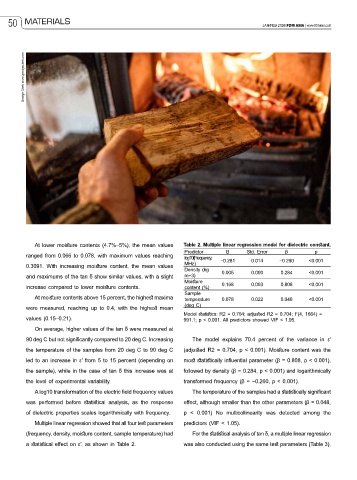
          90 deg C but not significantly compared to 20 deg C. Increasing   The  model  explains  70.4  percent  of  the  variance  in  ε′
          the temperature of the samples from 20 deg C to 90 deg C   (adjusted R2 = 0.704, p < 0.001). Moisture content was the
          led to an increase in ε′ from 5 to 15 percent (depending on   most statistically influential parameter (β = 0.808, p < 0.001),
          the sample), while in the case of tan δ this increase was at   followed by density (β = 0.284, p < 0.001) and logarithmically

          the level of experimental variability.             transformed frequency (β = −0.260, p < 0.001).
            A log10 transformation of the electric field frequency values   The temperature of the samples had a statistically significant
          was  performed  before  statistical  analysis,  as  the  response   effect, although smaller than the other parameters (β = 0.048,
          of dielectric properties scales logarithmically with frequency.   p  <  0.001)  No  multicollinearity  was  detected  among  the
            Multiple linear regression showed that all four test parameters   predictors (VIF < 1.05).
          (frequency, density, moisture content, sample temperature) had   For the statistical analysis of tan δ, a multiple linear regression
          a statistical effect on ε′, as shown in Table 2.   was also conducted using the same test parameters (Table 3).

