


Page 56 - FDMAsia Jul/Aug 2026
P. 56
54   MATERIALS                                                                    JUL/AUG 2026 FDM ASIA | www.fdmasia.com


         PICRYL                                              (1 USD = 5.20 BRL).
                                                                Production cost in motor-manual forest cutting was estimated
                                                             per cubic metre of wood produced, considering total operating
                                                             cost per effective working hour and productivity.
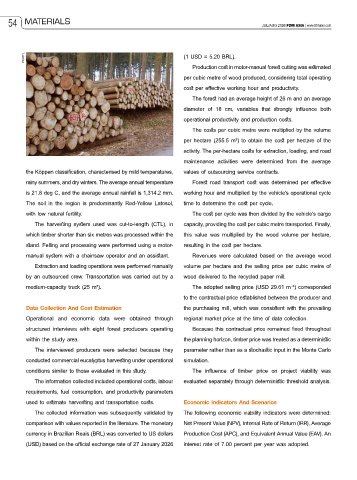
                                                                The forest had an average height of 26 m and an average
                                                             diameter  of  18  cm,  variables  that  strongly  influence  both

                                                             operational productivity and production costs.
                                                                The costs per cubic metre were multiplied by the volume
                                                             per hectare (255.5 m³) to obtain the cost per hectare of the
                                                             activity. The per-hectare costs for extraction, loading, and road
                                                             maintenance  activities  were  determined  from  the  average
          the Köppen classification, characterised by mild temperatures,   values of outsourcing service contracts.
          rainy summers, and dry winters. The average annual temperature   Forest  road  transport  cost  was  determined  per  effective
          is 21.8 deg C, and the average annual rainfall is 1,314.2 mm.   working hour and multiplied by the vehicle's operational cycle
          The  soil  in  the  region  is  predominantly  Red-Yellow  Latosol,   time to determine the cost per cycle.

          with low natural fertility.                           The cost per cycle was then divided by the vehicle's cargo
            The  harvesting  system  used  was  cut-to-length  (CTL),  in   capacity, providing the cost per cubic metre transported. Finally,
          which timber shorter than six metres was processed within the   this  value  was  multiplied  by  the  wood  volume  per  hectare,
          stand. Felling and processing were performed using a motor-  resulting in the cost per hectare.
          manual system with a chainsaw operator and an assistant.   Revenues  were  calculated  based  on  the  average  wood
            Extraction and loading operations were performed manually   volume  per  hectare  and  the  selling  price  per  cubic  metre  of
          by  an  outsourced  crew. Transportation  was  carried  out  by  a   wood delivered to the recycled paper mill.

          medium-capacity truck (25 m³).                        The adopted selling price (USD 29.61 m⁻³) corresponded
                                                             to the contractual price established between the producer and
          Data Collection And Cost Estimation                the purchasing mill, which was consistent with the prevailing
          Operational  and  economic  data  were  obtained  through   regional market price at the time of data collection.
          structured interviews with eight forest producers operating   Because this contractual price remained fixed throughout
          within the study area.                             the planning horizon, timber price was treated as a deterministic
            The  interviewed  producers  were  selected  because  they   parameter rather than as a stochastic input in the Monte Carlo
          conducted commercial eucalyptus harvesting under operational   simulation.
          conditions similar to those evaluated in this study.   The  influence  of  timber  price  on  project  viability  was

            The information collected included operational costs, labour   evaluated separately through deterministic threshold analysis.
          requirements,  fuel  consumption,  and  productivity  parameters
          used to estimate harvesting and transportation costs.   Economic Indicators And Scenarios
            The  collected  information  was  subsequently  validated  by   The following economic viability indicators were determined:
          comparison with values reported in the literature. The monetary   Net Present Value (NPV), Internal Rate of Return (IRR), Average
          currency in Brazilian Reais (BRL) was converted to US dollars   Production Cost (APC), and Equivalent Annual Value (EAV). An
          (USD) based on the official exchange rate of 27 January 2026   interest rate of 7.00 percent per year was adopted.

